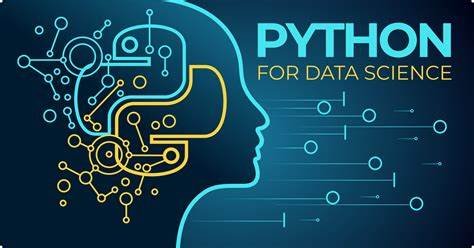
1. Introduction to Python for Data Science
Python is a versatile, high-level programming language widely used in data science. It’s particularly favored due to:
- Simplicity: Its syntax is easy to learn and use.
- Large Community: A robust ecosystem of libraries for data manipulation, analysis, and visualization.
- Scalability: Python can handle small datasets as well as large, complex datasets.
2. Essential Python Libraries for Data Science
Python’s efficiency in data science tasks is significantly enhanced by several libraries. These libraries provide functionalities ranging from data manipulation to complex machine learning algorithms.
| Library | Description | Usage |
|---|---|---|
| NumPy | Provides support for large, multi-dimensional arrays and matrices | Fundamental library for scientific computing and mathematical functions |
| Pandas | Offers data structures like DataFrames for manipulating structured data | Ideal for data wrangling, cleaning, and analysis |
| Matplotlib | 2D plotting library for visualizing data | Produces static, interactive, and animated visualizations |
| Seaborn | Statistical data visualization built on Matplotlib | Simplifies complex visualizations (e.g., heatmaps, pair plots) |
| scikit-learn | Machine learning library | Implements algorithms for classification, regression, and clustering |
| SciPy | Builds on NumPy, providing additional algorithms for optimization and signal processing | Used for advanced mathematical functions and technical computing |
| TensorFlow | Open-source platform for machine learning and deep learning | Focuses on building and training neural networks |
3. Data Manipulation with Pandas
Pandas is crucial for working with structured datasets (e.g., CSV files, Excel spreadsheets). It provides two key data structures:
| Pandas Object | Description |
|---|---|
| Series | One-dimensional labeled array that can hold any data type |
| DataFrame | Two-dimensional, size-mutable table with labeled axes |
Pandas supports several operations for data manipulation, including filtering, grouping, and merging.
| Operation | Description |
|---|---|
| Filtering | Extracting specific rows or columns of data |
| Grouping | Aggregating data based on categorical variables |
| Merging/Joining | Combining multiple datasets based on common keys |
4. Data Visualization with Matplotlib and Seaborn
Visualization helps in identifying patterns and gaining insights from data. Python provides several libraries for this purpose, the most prominent being Matplotlib and Seaborn.
4.1. Matplotlib
Matplotlib is a foundational plotting library in Python that allows users to generate various types of static visualizations.
| Type of Plot | Use Case | Example |
|---|---|---|
| Line Plot | Track changes over time or continuous data | Stock prices over time |
| Bar Plot | Compare categories | Sales data by product |
| Histogram | Show data distribution | Distribution of exam scores |
| Scatter Plot | Visualize relationship between two variables | Relationship between height and weight |
4.2. Seaborn
Seaborn extends Matplotlib by simplifying the creation of informative statistical visualizations. It is commonly used to create more aesthetically pleasing and complex plots.
| Seaborn Plot Type | Use Case | Example |
|---|---|---|
| Heatmap | Display data in matrix format | Correlation matrix |
| Pair Plot | Visualize pairwise relationships in a dataset | Relationship between multiple variables in a dataset |
| Box Plot | Summarize data distribution | Distribution of salaries by job level |
5. Machine Learning with scikit-learn
scikit-learn is a robust library for machine learning that provides simple and efficient tools for data mining and data analysis. It supports various machine learning algorithms for:
| Type of Algorithm | Description | Example Use Case |
|---|---|---|
| Classification | Predict categorical labels (e.g., yes/no) | Email spam detection |
| Regression | Predict continuous values | Predicting house prices |
| Clustering | Group data points without predefined labels | Customer segmentation |
| Dimensionality Reduction | Reduce the number of features in a dataset to simplify models | Feature selection in large datasets |
| Algorithm | Description | Example |
|---|---|---|
| Linear Regression | Models the relationship between variables | Predicting sales based on advertising spend |
| K-Nearest Neighbors | Classifies data based on proximity to neighbors | Image classification |
| K-Means Clustering | Groups similar data points into clusters | Grouping customers based on buying behavior |
6. Data Processing and Cleaning
Before applying machine learning algorithms, data must be cleaned and pre-processed. Common tasks include:
| Task | Description | Example |
|---|---|---|
| Handling Missing Data | Filling in or removing missing data points | Filling missing salary values with average |
| Feature Scaling | Standardizing data to ensure consistent ranges across variables | Normalizing data for machine learning algorithms |
| Encoding Categorical Data | Converting non-numeric data into a numeric format for analysis | Transforming “Male/Female” into 0/1 |
7. Deep Learning with TensorFlow and Keras
For more advanced tasks like image recognition and natural language processing, Python offers libraries such as TensorFlow and Keras, which are used to build neural networks.
| Library | Description | Use Case |
|---|---|---|
| TensorFlow | Open-source machine learning framework, focused on deep learning | Developing and training neural networks |
| Keras | High-level API for building neural networks, built on top of TensorFlow | Building image classification models |
Common deep learning tasks include:
| Deep Learning Task | Description | Example Use Case |
|---|---|---|
| Image Classification | Categorizing images based on their content | Identifying objects in pictures |
| Natural Language Processing (NLP) | Analyzing and understanding human language | Sentiment analysis, text summarization |
Course Features
- Lecture 0
- Quiz 0
- Duration 10 weeks
- Skill level All levels
- Language English
- Students 0
- Certificate No
- Assessments Yes